

You've Been Handling This for Decades. That Hasn't Changed
The question isn't whether you're capable of doing your laundry. You've been doing it longer than most people advising you on the topic have been alive. The question worth asking honestly is whether it makes sense to keep doing it the same way, now that the physical demands of the task have started to cost more than they used to.
This page is for people who've noticed that change — and want to think through their options clearly, without being talked at or talked into anything.
What's Actually Changed — And Why It's Worth Knowing
Laundry is more physically demanding than it looks from the outside. A full basket weighs 15 to 20 pounds — more when wet. The machine sits at floor level, or requires leaning over the edge. Folding a full load means sustained time on your feet. These are accurate descriptions of what the task requires, not complaints. And what it requires has started to intersect with something worth paying attention to.
The CDC reports that one in four adults 65 and older falls each year, and falls are the leading cause of injury-related death in that age group. They happen most often during ordinary physical tasks — carrying something heavy, bending at an awkward angle, navigating a floor-level obstacle. Laundry involves all three, repeatedly. That's not a reason for alarm. It's a reason to make deliberate decisions about how the task gets done, which is exactly what this page is for.
Geriatricians formally assess laundry as part of evaluating whether someone is managing safely at home — it's one of eight tasks on the standard clinical scale used to measure functional independence. When laundry has become more difficult, that's a recognized situation with practical, available responses. Knowing that changes the frame: this isn't about admitting something is wrong. It's about having accurate information and deciding what to do with it.
If you're reading this on behalf of a parent or someone you care for — you're in the right place too. The rest of this page speaks primarily to the person making the decision, because that's who it should belong to. But there's more at the end specifically for family members thinking through how to help.
Common Challenges


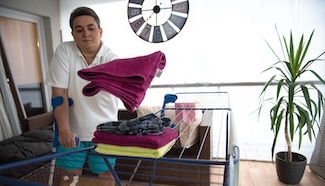
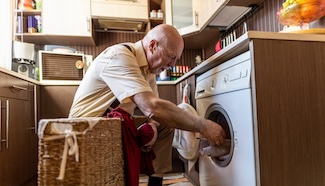

The Reframe That Changes the Decision
There's a version of this that feels like a concession — like accepting help with laundry signals something larger about what's changing. That reaction is understandable. It's also worth examining.
Managing a home well has always meant making practical decisions about which tasks to handle and which to hand off. That calculation has shifted throughout your life — not because your capability changed, but because circumstances did. Using a laundry service is that same kind of decision. The goal was never to do every task yourself regardless of what it costs. The goal was to stay in your home, on your terms, with your life running well.
A service that removes a task that has become physically demanding or risky doesn't compromise that goal. It protects it. Choosing to use one is a demonstration of exactly the kind of clear-eyed judgment that keeps a person living independently and well.
If that's an argument you've been making to yourself and haven't quite landed, or one you need language for when explaining a decision to someone in your family, Stop the Laundry Spiral: When It Makes Sense to Outsource covers the decision framework in full — including how to recognize when the trade-off genuinely makes sense and how to articulate why.
What the Service Actually Removes
No basket to carry to the machine, or down the stairs, or to the car. No bending to load a front-loader from floor level. No reaching into a top-loader. No wet clothes to transfer. No standing to fold a full load. No stairs navigated with weight in your arms.
The laundry leaves in a bag from your door. It comes back clean, dried, and folded. The physical demands that have been quietly adding up — the ones that require planning around, that come with a small calculation before each load — simply don't happen.
What that frees up isn't dramatic. It's the Tuesday morning that goes the way Tuesday morning was supposed to go. The energy that used to go toward working around laundry going toward something you'd actually choose. The absence of a task that had been sitting in the back of your mind as something to get to. Small, but consistent.
Your items are handled according to the care preferences you specify. If certain pieces have always been washed a particular way, that gets noted and followed. Providers on established platforms are vetted and reviewed — their work is accountable in ways that make reliability a standard rather than a hope. And if something goes wrong, which is rare, policies exist for addressing it directly.
If you're still working out whether this makes sense against continuing to manage it yourself, Laundry Service vs. Doing It Yourself — The Real Tradeoffs covers the honest comparison — what each option actually involves, week to week, and where each one holds up.


Find Out What's Available Near You
Poplin operates in cities and towns across the country, with vetted local providers handling pickup, washing, folding, and delivery. The service can be arranged directly or set up by a family member — whichever fits how you prefer to handle it. Most first orders are picked up within 24 hours.