
Need Help With Laundry
Due to Disability
or Health Issues?

You Haven't Failed at Laundry. Laundry Has Become Genuinely Hard.
There's a version of laundry that most people do without thinking — haul the basket, load the machine, transfer the wet clothes, fold the load, put it away. A sequence of physical tasks so routine it barely registers as effort.
For you, each of those steps is a calculation. Can I lift that right now? Will bending down cost me more than I can afford today? Is this the task that uses up what I have left, or is there something more important that still needs doing? The laundry is the same laundry. The body doing it is working under conditions that make each step meaningfully harder — sometimes impossible — in ways that don't require explanation to anyone who lives with a chronic condition.
This page is for people who already understand their situation. It's here to put words to the specific ways laundry intersects with it.
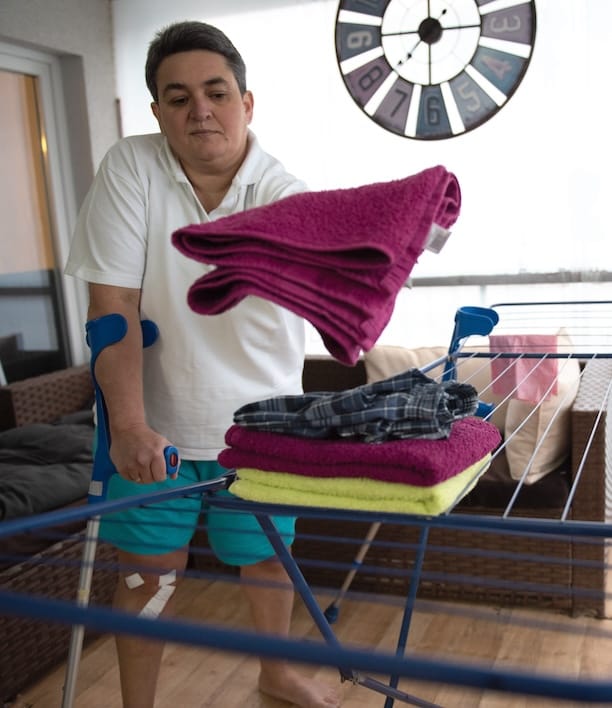
The Physical Barriers Are More Specific Than They Look
Laundry isn't one task — it's a sequence of distinct physical demands, and any one of them can be the obstacle on a given day.
A standard load of dry laundry weighs between 15 and 25 pounds. Wet clothes weigh 30 to 50 percent more. Loading a front-loader means bending to a drum that sits close to the floor. A top-loader requires leaning in and reaching down while holding wet, heavy clothes. Folding a full load means sustained time on your feet or in a position that isn't always available. Any of these steps, on a hard day, can be the one that makes laundry unmanageable. On a very hard day, all of them stack.
For people living with conditions that affect systemic energy — fibromyalgia, MS, COPD, and others — the barrier goes beyond physical mechanics. The available energy on a flare day is finite and non-negotiable. Spending it on laundry isn't just tiring; it's a resource allocation decision with consequences for everything else. Getting dressed. Preparing food. Managing whatever the rest of the day requires. A task that looks minor from the outside can exhaust what the body has available for all of it.
This Is a Recognized Functional Limitation — Not a Personal Failing
Healthcare providers formally assess laundry as part of what's called Instrumental Activities of Daily Living — IADLs — a defined category of tasks that indicate a person's ability to manage independent life. When a patient struggles with laundry, clinicians don't tell them to try harder. They document it as a functional limitation and factor it into care planning.
That framing exists for a reason. If laundry has become difficult or impossible on some days, that is what is happening. It doesn't require minimizing, explaining, or apologizing for.
Why It Tends to Compound
One hard day becomes two. The laundry that didn't get done on Tuesday is still there on Thursday, and now there's more of it. By the time a window opens — a better day, a stretch of manageable symptoms — the load is larger and heavier than it would have been. The compounding isn't a failure of planning. It's a predictable consequence of a task that doesn't pause when capacity does.
What People in Your Situation Are Doing About It
There's a fuller conversation worth having about what makes laundry hard for people managing chronic conditions — and what actually helps. It covers the full range of options available, from strategies that reduce the physical demands of doing laundry yourself to services that remove the task from your plate entirely.
Common Challenges