


You're Not Bad at Laundry. Laundry Is Just Built This Way.
Laundry is one of the only household chores that never actually finishes. If laundry has started to feel like more than a chore, you're in the right place. You can complete dishes, cross off a grocery run, call a cleaning day done. Laundry resets the moment it's complete. Someone gets dressed, something gets dirty, the cycle starts again — and it has been starting again, without pause, your entire adult life.
That's not a failure of organization. It's the nature of the task. And for millions of people, the cumulative weight of that never-ending cycle tips from manageable into something heavier: a persistent low-grade stress, a sense of always being behind, a chore that quietly consumes more mental space than it has any right to.
Why Laundry Hits Differently Than Other Chores
The emotional weight of laundry isn't random, and it's not a personal quirk. There are real reasons it accumulates the way it does.
It Never Closes
Psychologists use the term Zeigarnik effect to describe what happens with unfinished tasks: the brain keeps an open tab for anything incomplete, quietly consuming mental energy even when you're not actively thinking about it. Because laundry is structurally never finished, that tab never closes. It runs in the background constantly — a low hum of awareness that contributes to cognitive fatigue over time. You can be nowhere near your laundry room and still be tired from it.
The Volume Is Genuinely Significant
The average American household generates between 8 and 10 loads of laundry per week. Over a year, even moving efficiently, that translates to roughly 200 hours of active laundry time — sorting, transferring, folding, putting away. That's more than a month of full workdays, every year, on a single chore. The expectations around laundry often don't reflect what it actually demands.
It Carries Moral Weight It Doesn't Deserve
Clean clothes are tied to responsibility, care, and competence in ways that clean floors simply aren't. Falling behind rarely feels neutral — it tends to feel like evidence. Of being overwhelmed, of dropping the ball, of not having it together. That emotional charge is culturally loaded and largely unfair, but it's real, and it makes the pile harder to face than its physical size alone would suggest.
It Compounds Invisibly
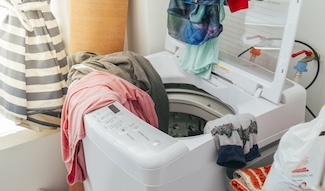
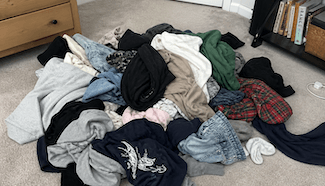
Laundry overwhelm rarely arrives all at once. It builds gradually — a week behind, then two, then the routine stops working and the pile becomes a permanent presence in the home. By the time most people recognize they need a different approach, the problem is already layered: the backlog, the ongoing volume, the guilt about the backlog, and the exhaustion of carrying all of it while life continues at full speed.
Common Challenges




What Actually Helps
The honest answer is that different approaches work for different households — and most people try several before landing on something that sticks. What matters is finding a solution that fits your actual circumstances, not the version of your life where you have more time and energy than you currently do.
Routine and systems are where most people start, and reasonably so. Running one load per day, sorting at the hamper instead of at the machine, doing laundry on a fixed schedule — these approaches reduce the mental overhead of deciding when to do it and can keep volume from compounding. They work best when the problem is mild and life is relatively stable. When circumstances shift — a new baby, a heavier season at work, an illness — even well-built routines tend to break down, and rebuilding them while already behind is its own challenge.
Sharing the load is the next move for most households. Getting a partner, older kids, or other household members genuinely involved — not as occasional helpers, but as consistent owners of specific parts of the process — can meaningfully reduce the pressure on one person. This is harder to sustain than it sounds; laundry responsibility has a way of drifting back to whoever cared most in the first place. But when it works, it works.
Reducing the volume is underused as a strategy. Fewer clothes per person means less laundry per week, and some households find that a modest wardrobe reduction — not a minimalist overhaul, just a deliberate trim — makes the weekly load genuinely more manageable. This addresses the source rather than the symptoms, though it's a slow fix and doesn't help with an existing backlog.
Outsourcing some or all of it is the option most people reach last, usually after the others have stopped working. Wash-and-fold services and laundry pickup apps have expanded significantly in recent years, and for households where laundry has become genuinely unmanageable, handing it off tends to land differently than expected — less a luxury, more a meaningful reduction in the cognitive and emotional load laundry has been generating, often for longer than people realized.
For some households, some of the time, the first three approaches are enough. But there's a version of this problem — chronic, compounding, tied to a life that's already running at capacity — where optimizing your own effort isn't going to close the gap.


When Outsourcing Makes Sense
When the issue isn't how you're doing laundry but how much of your life it's consuming, the more direct solution is doing less of it yourself.
The premise is simple: your laundry is picked up, cleaned, folded, and returned. You don't sort it, monitor it, transfer it, or fold it. The task gets finished — completely finished — and the mental tab that's been running in the background finally closes. The ongoing stress, the guilt, the constant low-level awareness that it's there and growing — those go away with the pile.
The practical questions are worth thinking through carefully rather than assuming the answer. Most people find that when they account honestly for their time, energy, and the stress laundry has been generating, the math on outsourcing looks different than they expected. If you're still weighing whether it makes financial sense for your household, Is a Laundry Service Worth It? Cost, Time, and Stress Compared works through the trade-offs honestly.
It also helps to step back and look at the full picture — not just the dollar amount, but what you're actually trading when you do laundry yourself versus handing it off. Time, energy, stress, and money all factor in, and they don't always point the same direction. Laundry Service vs Doing It Yourself — The Real Tradeoffs works through the comparison honestly so you can make the call that fits your situation.
Ready to Make a Change?
The through line across every version of laundry overwhelm is the same: the problem compounds quietly until it's big enough to be undeniable, and by then the standard fixes feel inadequate to the scale of it. That's not a sign that you waited too long or made the wrong choices. It's just how this particular chore works on people over time.
What changes things is being honest about what you're actually dealing with — the real volume, the real mental load, the real cost in time and stress — and choosing an approach that fits that reality. For some people that's a better system. For others it's sharing the work more equitably. For a growing number, it's deciding that their time and energy are worth more than the money it costs to stop doing laundry themselves.
If you're past the weighing stage and trying to decide whether now is the right time to make a change, Stop the Laundry Spiral: When It Makes Sense to Outsource is the more direct read. Or if you're ready to see what's available where you live, enter your zip code below to see if we can help.