

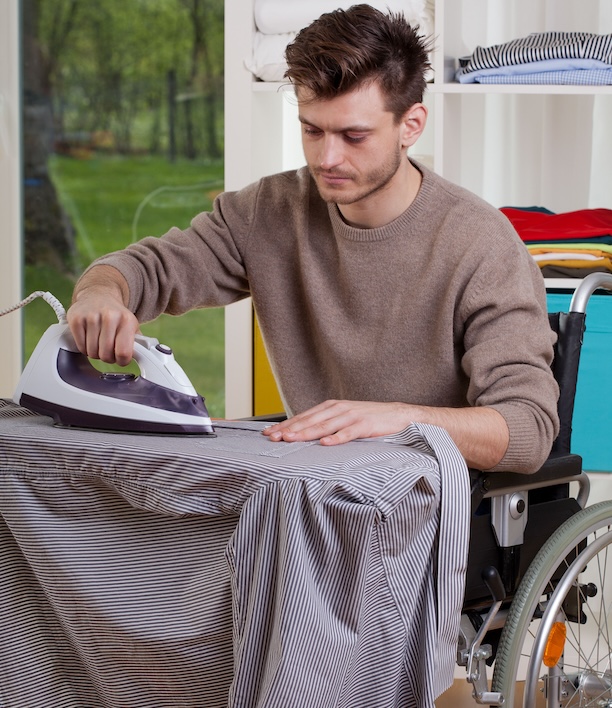
For Many People, the Barrier to Laundry Isn't Time or Motivation. It's the Physical Demand of the Task Itself.
Most conversations about laundry focus on time or motivation. For a significant portion of the population, the real barrier is neither — it's what the task physically requires. Carrying, bending, lifting, standing, climbing stairs with weight in your arms. Laundry isn't one task. It's a chain of physically demanding steps that repeats multiple times a week without pause, and for anyone whose body places real limits on what those steps cost, there is no way to skip a step, no version of the task that gets easier on its own, and no rest in the middle without the problem growing while you wait.
This page is for anyone navigating that reality — regardless of what's causing it. Whether the difficulty comes from a chronic condition, a recent surgery, changes that come with age, or something harder to name, the physical demands of laundry are the same. What differs is the situation. This page covers both — what makes laundry physically difficult, and what actually helps.
The Scale of the Problem
More people are navigating physical difficulty with everyday tasks than most conversations about laundry acknowledge.
The CDC reports that 28.7 percent of adults in the United States — more than 70 million people — have some form of disability. Physical disability, affecting mobility and movement, is the most common type, reported by 1 in 7 adults. That number doesn't include the full population managing chronic pain, recovering from surgery, or navigating age-related changes that haven't crossed a clinical threshold but are real nonetheless.
For all of them, household tasks that the general population treats as minor chores — laundry among them — represent genuine, recurring physical challenges. The difficulty is common. It's just rarely named out loud.
Why Laundry Is Specifically Difficult — and Clinically Recognized as Such
Laundry occupies a specific place in the clinical assessment of physical function. The Lawton Instrumental Activities of Daily Living Scale — the standard tool geriatricians and occupational therapists use to evaluate whether a person can manage independently at home — includes laundry as one of eight core tasks. When a patient reports difficulty with laundry, it doesn't get noted as a minor inconvenience. It's recorded as a functional limitation with implications for care planning and independence.
Occupational therapists break laundry into five distinct physical sub-tasks, each with its own demands:
Gathering and carrying. A standard dry load of laundry weighs 15 to 25 pounds. Wet clothes transferred from washer to dryer are 30 to 50 percent heavier. This is a meaningful load for anyone managing reduced grip strength, joint pain, or balance changes — and it has to happen at least twice per load.
Loading the washer. A front-loading machine requires bending to drum level. A top-loader requires leaning over and reaching down. Both positions put strain on the lower back, hips, and shoulders, and both require stability that isn't always available.
Transferring wet laundry. Moving a wet load from washer to dryer is the heaviest single physical demand in the laundry sequence. It combines lifting with an awkward reach, often while standing on a hard floor.
Folding. A full load requires sustained time on the feet, typically in a slight forward lean. For anyone managing back pain or fatigue, this is where the task's cumulative cost becomes most visible.
Navigating the space. If machines are in a basement or a room requiring stairs, every load involves carrying weight through a transition that concentrates risk.
A 2025 study published in Scientific Reports found that pain was associated with a 21.1 percent increase in reported difficulty with heavy housework — and of all IADL tasks studied, heavy housework had the strongest association with pain limitations. Laundry, by any measure, qualifies.
Common Challenges
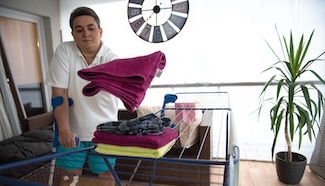
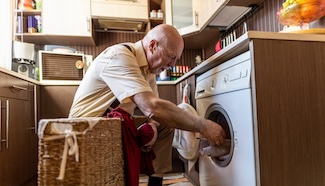



Laundry, Falls, and Why Discharge Instructions Name It Specifically
Falls are the leading cause of injury and injury-related death among adults 65 and older. The CDC reports that one in four older adults falls each year — but falls happen across age groups, and they happen most often during ordinary physical tasks involving carrying, bending, or navigating stairs with weight.
Laundry involves all three, repeatedly. Carrying a loaded basket on stairs. Bending to floor level to load or unload a front-loader. Stepping over a basket left on the floor with arms full. Post-surgical patients face the same risk: bending to reach a washer drum and lifting a wet load both increase intra-abdominal pressure, which is why hospital discharge instructions — from institutions including Brigham and Women's and Atlantic Health — explicitly name laundry baskets as items patients should not carry during recovery.
The task appears in clinical restrictions because it creates a specific, documented category of risk — not as overcaution, but as an accurate assessment of what the physical sequence of laundry actually involves.
The Compounding Problem
For people who can do laundry conditionally — on good days, with the right energy, when pain is manageable — the task becomes irregular. Irregular laundry accumulates. When a window finally opens, the load is larger and heavier than it would have been, which makes it more physically demanding than it needed to be. The good-day window gets spent on a harder version of the task than it should have been.
The cycle is self-reinforcing: physical difficulty creates irregular laundry, irregular laundry creates larger loads, larger loads create greater physical demands. Without intervention, the gap between what the body can reliably do and what the laundry requires tends to widen rather than close.
What Actually Helps
The right approach depends on what's driving the difficulty and how significant the limitation is.
For people managing mild or intermittent physical difficulty, reducing the frequency of large loads — washing smaller amounts more often — can lower the peak demand of any single session. This doesn't eliminate the problem, but it keeps the heaviest moments lighter and more manageable.
For people with access to household support, redistributing the most physically demanding steps — carrying, transferring, folding — can make the difference between a manageable and an unmanageable task, at least during stretches when that support is consistent and available.
For people whose physical limitation makes the task genuinely unsafe, consistently unmanageable, or simply a recurring cost they've been absorbing for too long — removing laundry from the list of things they're responsible for is the most direct and durable solution. Wash-and-fold pickup services handle every physically demanding step in the sequence: the carrying, the loading, the wet transfer, the folding. None of it falls to the person whose body made those steps difficult in the first place. The laundry gets done reliably, on a schedule that doesn't depend on good days or available help, and the physical risk that each load was quietly carrying disappears with it.
For most people navigating physical difficulty with laundry, this is the option that actually closes the gap rather than managing it. The others reduce the problem. This one removes it.
If the idea of handing off laundry entirely is still taking shape, The Easiest Way to Take Laundry Off Your To-Do List is a useful starting point — it covers what the process actually involves and what most people find once they've tried it. For a more detailed look at the pickup logistics specifically, How Laundry Pickup and Delivery Actually Works covers the mechanics directly. And for older adults, people with disabilities, or anyone trying to identify a service that handles their laundry safely and reliably, How to Find Safe, Trusted Laundry Help for Seniors or Disabled Adults covers what to look for, what questions to ask, and what trustworthy services are accountable for.
The Physical Demands of Laundry Don't Negotiate With the Body's Limits
Laundry will keep requiring what it requires — the lifting, the bending, the carrying, the standing. That doesn't change. What can change is who it's requiring those things from. For anyone whose body has made the honest calculation that those demands are no longer safe, sustainable, or worth absorbing, there are practical options that don't require pushing through or finding workarounds. The pages in this section are designed to help you find the one that fits your situation — and get the laundry handled without it costing you more than it should.
Find Help Near You
Laundry pickup and wash-and-fold services are available in cities and towns across the country. Availability, pricing, and provider options vary by location.