
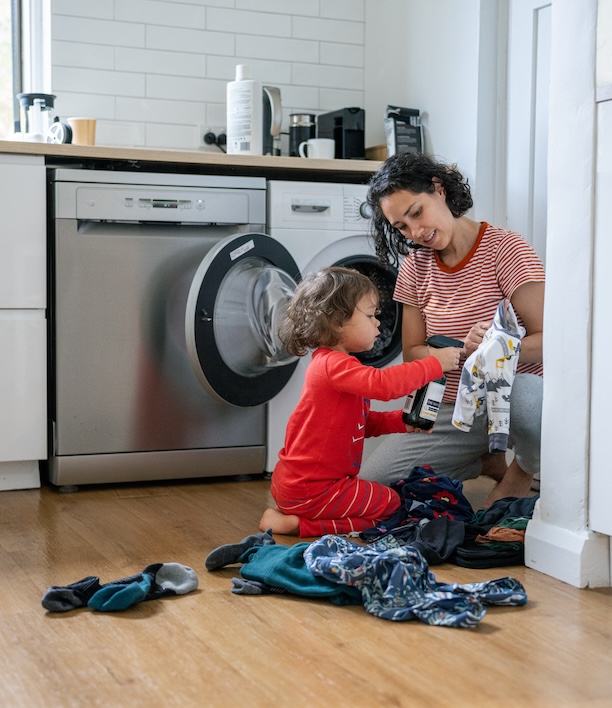
The Laundry Didn't Used to Be This Much
Before the household grew, laundry was a chore. Manageable, forgettable, occasionally annoying — the kind of task that got done without much drama. Then it changed. More people, smaller clothes, more outfit changes per day, more uniforms with game-day deadlines, more bedding after accidents, more of everything. And for families also caring for an aging parent — adding their laundry to the household's load, or managing the logistics of theirs from a distance — the weight compounds in ways nobody quite prepares you for.
You're not less capable than you were before. You're managing a structurally different workload. This page is for families at that point — not for tips on staying organized, and not for a lecture on laundry habits. For an honest look at why family laundry is harder than general advice accounts for, and what actually helps.
Why Family Laundry Is a Different Category of Problem
A single person doing laundry is managing a volume problem with a reliable routine. Add two or three children — or an aging parent whose laundry has become part of what the family manages — and the problem changes shape entirely.
The volume alone is significant. A family of four typically generates 20 to 30 pounds of laundry per week — more than double what a single-person household produces, before accounting for the specific ways children generate laundry. A single outfit rarely survives a full day. Sports and activities produce uniforms that need to be clean by a specific time. Bedding needs washing after accidents. Seasonal wardrobe changes mean irregular bulk loads on top of regular weekly volume.
Family laundry also carries deadlines that adult laundry doesn't. The uniform needed for Saturday's game. The costume for Friday's school event. The one pair of pants that fits right now. When the laundry is behind — and with kids, it frequently is — those deadlines arrive with consequences at 7am that someone has to manage.
For families also helping an aging parent, the complexity extends further. A parent's laundry may need to be handled separately, driven to and from their home, or coordinated around their schedule and physical limitations. It's one more recurring responsibility that quietly joins the list of things the family absorbs.
And then there's the invisible layer underneath all of it: knowing what's clean, what's dirty, what's been worn twice, whose uniform has a grass stain that needs pretreating, when the sheets were last changed. This overhead doesn't show up in the laundry basket. It lives in one parent's head, running continuously alongside everything else the day requires — and the research on household labor consistently finds that it falls disproportionately on one person, cumulating in ways that are real and rarely acknowledged.
What Keeps Family Laundry From Getting Done
The standard advice — one load a day, a designated laundry day, getting kids involved — is calibrated for a household with more predictability than most families actually have.
One load a day requires the day to cooperate. Parenting doesn't offer that reliably. The load that was supposed to go in before school didn't happen because someone was sick. The folding that was going to happen after bedtime didn't happen because bedtime took ninety minutes and now there's nothing left. Getting kids involved helps at the margins and requires ongoing management to sustain — which means the task didn't get lighter, it just redistributed slightly.
What doesn't get talked about enough is the compounding effect. A family that falls one load behind is three loads behind by Thursday. A week where the routine breaks leaves a weekend consumed by catch-up that was supposed to be for something else. The backlog isn't a character flaw. It's a predictable result of a workload that doesn't pause when the week goes sideways.
If Any of This Sounds Like Your Household
The laundry is always either caught up or behind, with nothing in between — and "caught up" lasts about two days. The weekend keeps getting absorbed by a catch-up session that was supposed to be for something else. One parent is carrying the tracking, the managing, and most of the doing, and it's wearing in ways that are hard to explain to someone who isn't in it. A parent who used to manage this fine has had their capacity reorganized by a new baby, a schedule change, or a season of life that's simply heavier than the one before. Or there's a parent on the other end of the age spectrum now — an aging mom or dad whose laundry has quietly become part of what the family is figuring out.
If you recognized your household in any of that, the pages below speak to the specific version of this you're dealing with. The section after those is for what to do about it.
Common Challenges





What Actually Helps — And What It Feels Like When It Does
The honest answer is that the solutions most families try first — better systems, more consistent habits, more family participation — address the management of the problem rather than the size of it. They're worth trying, and they have real limits. If you've already tried several and watched the same pattern reassemble itself, Stop the Laundry Spiral: When It Makes Sense to Outsource is worth reading before trying another variation of the same approach. The limit is the volume. A family generating 25 to 35 pounds of laundry per week is dealing with a workload that one person managing an already full life cannot reliably absorb on top of everything else. Optimizing the routine helps. It doesn't change the fundamental math.
What changes the math is removing the laundry from the list of things that person has to do.
Here's what that actually looks like: It's Tuesday morning and the uniform is clean. Not because you remembered to run it Sunday night and caught the dryer in time. Just — clean, folded, in the drawer. The Saturday game doesn't require a Wednesday mental note or a Thursday load that has to happen or a Friday night contingency. It just happens.
The sheets get changed without it being a whole thing. The backlog that was accumulating toward the weekend doesn't arrive. Sunday isn't a catch-up day. It's Sunday.
That's what wash-and-fold pickup service actually delivers for families — not a marginally better version of the laundry routine, but the removal of the routine as something that requires managing at all.
Think of it the way most families think about a dishwasher or a grocery delivery subscription: not a luxury, not a treat, but household infrastructure. A tool that moves a recurring domestic task off the list of things requiring active management. If you're still working out whether the cost makes sense for your household — and what doing laundry yourself is actually costing when time and mental load are part of the calculation — Is a Laundry Service Worth It? Cost, Time, and Stress Compared works through the full picture honestly.
And if the decision is less about the economics and more about whether this is something you can realistically set up and maintain alongside everything else already on your plate, The Easiest Way to Take Laundry Off Your To-Do List covers what getting started actually involves — and why it's simpler than most families expect.


Find Help Near You
Poplin operates in cities and towns across the country, with local vetted providers handling pickup, washing, folding, and delivery. Most first orders are picked up within 24 hours — and the service can be set up and managed on behalf of an aging parent as easily as for your own household.