
Pickup vs Laundromat:
Which Is Actually
More Convenient?

A direct comparison across the dimensions that actually matter: time, cost, scheduling, and consistency. If the laundromat is the right answer for your situation, this article will tell you. If pickup service is, it will tell you that too.
If You're Here, Laundry Is Already Costing You More Than It Should
Maybe you're short on time and laundry keeps falling behind. Maybe you're managing without in-unit machines and trying to figure out what actually fits your life. Maybe you've been going to the laundromat for years and recently started wondering whether there's a better way.
Whatever brought you here, the underlying question is the same: is there a way to handle laundry that doesn't keep costing you this much — in time, in logistics, in the low-grade friction of a chore that never quite stops demanding attention?
This guide answers that question by comparing two options directly: the laundromat and pickup-and-delivery service. Both work. Neither is right for every situation. The goal is helping you figure out which one is right for yours.This guide is most useful if you:
- Currently use a laundromat and are questioning whether it's the best option
- Are managing without in-unit machines and evaluating your options for the first time
- Have tried pickup service and want to understand the tradeoffs more clearly
If you're starting from scratch on understanding your options, No Washer or Dryer? Here Are Your Best Options covers the full landscape before narrowing to this comparison.
The Time Comparison — Full Accounting
This is where most informal comparisons go wrong. They count the cash and estimate the time loosely, when time is often the more significant variable.
Active time at the laundromat — loading machines, moving clothes, folding — typically runs 30 to 45 minutes per visit. That's the number people cite when they say laundry doesn't take that long.
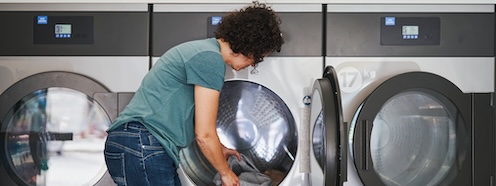
Total time at the laundromat is different. Add gathering laundry and getting it into bags, traveling to and from the location, and waiting through a wash cycle (30–45 minutes) and a dryer cycle (45–60 minutes). Most laundromat visits, fully accounted, take 90 minutes to two and a half hours.
Over a year at one visit per week: 78 to 130 hours. At two visits per week for larger households, it's more.
Pickup and delivery requires scheduling a pickup — five minutes from a phone — and leaving a bag at your door during the pickup window. No presence required. Total active time per week: under ten minutes. Total elapsed time: 24 to 48 hours, during which you're doing other things entirely.
The time comparison isn't close. The cash comparison is more nuanced.

The Cost Comparison — Done Honestly
The number most people don't run: A laundromat visit takes 90 minutes on average. For someone earning $25/hour, that's $37.50 in time — before a dollar of cash changes hands. At $40/hour, it's $60. A pickup order for a single person typically runs $20–$40. For many households, the laundromat costs more in total than the service they've been assuming they can't afford.
A laundromat wash cycle costs $2–$4. A dryer cycle runs $1.50–$3. Per load, that's $3.50–$7, plus transportation.
A pickup service costs $1.50–$2.50 per pound. A single person's weekly laundry runs 8–12 pounds — $12–$30 per week. A family of four generates 20–30 pounds — $30–$75 per week.
On a per-load basis, the laundromat is cheaper. That's true and worth saying directly.
On a total cost basis — once time and transportation are counted — the gap is smaller than it appears, and for many households it inverts entirely. The math is worth running with your own numbers. Pricing for services in your area is available at the local pricing page.
The Scheduling Question
The laundromat requires your physical presence at a specific location during operating hours, with machines available when you arrive. When the week cooperates, this is manageable. When it doesn't — a long day, an unexpected obligation, a schedule that shifted — the laundry gets pushed, and the backlog grows.
Pickup service schedules around you. You choose the window; you don't need to be there for handoff. If the week shifts, you reschedule. The service doesn't depend on conditions that may or may not materialize.
For people with variable schedules or demanding weeks, this flexibility is often the deciding factor. The laundromat trip that keeps getting pushed is the trip that eventually becomes a two-week backlog.
The Consistency Question
Laundromat results depend on the machines available, how well they're maintained, and the choices made under time pressure. Generally adequate — but variable in ways outside your control.
Pickup results depend on the provider. Well-reviewed, accountable providers are consistently reliable: care notes followed, items handled the same way every time, no variation from week to week. The consistency advantage goes to pickup service — with the caveat that provider quality varies, and checking individual provider reviews rather than platform-level ratings is the more reliable predictor of what you'll actually get.
The Objections, Answered Directly
"The laundromat is obviously cheaper." On a per-load basis, often. On total cost — including time and transportation — less clearly. The hourly-rate calculation above is worth doing with your actual numbers before assuming the answer. Even if the laundromat comes out ahead in dollars, the question is whether that difference is worth what the time costs elsewhere in your life.
"I can run errands or get things done while I wait." Sometimes true, and genuinely useful when it works. The honest follow-up: is it consistently true? The strategy requires the right errands, the right timing, and the week cooperating. When it doesn't work out, the time is simply gone. Pickup service doesn't require the strategy to succeed. The time is yours regardless.
"Pickup isn't available or reliable in my area." The most legitimate reason to stay with the laundromat, and worth checking before assuming. Coverage has expanded considerably and is often more accessible than people expect. If service in your area is genuinely limited or poorly reviewed, the laundromat may simply be the better option — and that's a valid conclusion, not a failure.
"I like being in control of how my laundry is done." A real preference worth taking seriously. The question is what that control produces. For most standard household laundry, a reliable pickup service delivers results indistinguishable from what you'd do yourself. For specific items with specific care requirements, flag them or keep them out of the order. For everything else, the question is whether the preference for control is producing meaningfully better outcomes — or just requiring more of your time to achieve the same ones.
Which Option Is Actually Right for You
The laundromat is the stronger choice when:
- Pickup service isn't available or well-reviewed in your area
- Your schedule is genuinely flexible and a nearby laundromat is reliable
- You're running large, infrequent loads that benefit from multiple machines simultaneously
- Cash cost is the primary constraint and time cost is less of a factor
Pickup service is the stronger choice when:
- Your schedule is variable or consistently full and scheduling a laundromat visit creates friction
- The time cost of laundromat visits — two hours a week, every week — is time you'd rather have back
- Physical effort, transportation, or access is a meaningful constraint
- You want a consistent, reliable result that doesn't depend on machine availability or timing
Find Out What It Costs in Your Area
Pricing and availability vary by location — what the comparison looks like for your household depends on real local numbers, not national averages. Enter your zip code to see what Poplin providers near you are currently charging.