
Laundry Help for
Seniors Who Want to
Stay Independent

Managing Your Home Well Means Knowing Which Tasks Are Worth the Risk.
You've been handling laundry your entire adult life. The routine is familiar, the process is straightforward, and the idea of needing help with it probably sits uncomfortably — as though accepting assistance with something this basic would mean something larger about what you can and can't manage.
It doesn't mean that. What it means is that you're paying attention — to the way the basket feels on the stairs, to the morning your back made the bend to the dryer harder than it should have been, to the quiet recognition that a task you've done a thousand times has started to carry a risk it didn't used to. Noticing that isn't a concession. It's judgment.
Why Laundry Deserves a Second Look
The CDC reports that one in four adults 65 and older falls each year. Falls are the leading cause of injury and injury-related death in that age group — not dramatic accidents, but ordinary moments where something went slightly wrong.
Laundry is full of those moments.
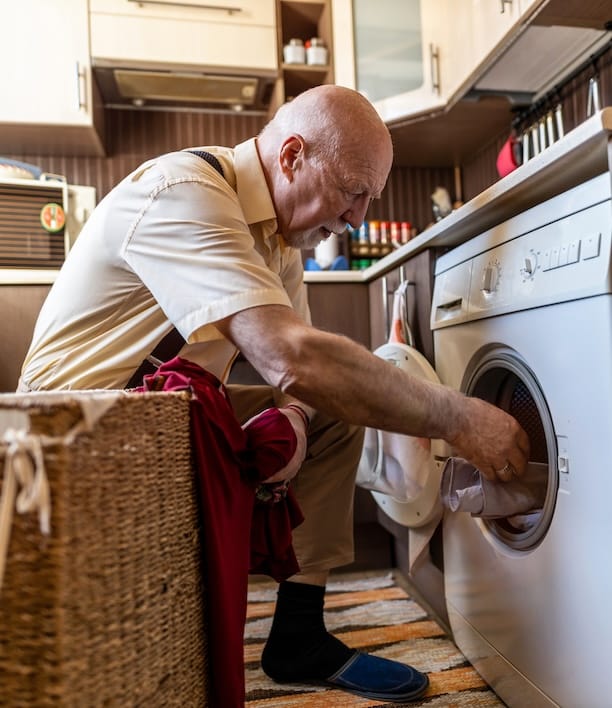
A week's worth of laundry weighs between 15 and 20 pounds dry — comparable to a small bag of dog food, or a toddler. Wet clothes moved from washer to dryer weigh between 20 and 30 pounds. That's not a trivial lift for anyone managing reduced grip strength, changes in balance, or joint discomfort. And the lift is only one part of the picture. Carrying a loaded basket while navigating stairs or uneven flooring. Bending to reach a front-loading drum that sits close to the floor. Stepping over a basket left on the floor while arms are full. Each of these is a moment where the margin for error is smaller than it used to be — and the cost of an error is high.
What Your Doctor Already Knows About This
Physicians who specialize in care for older adults formally assess laundry as part of evaluating functional independence. It's listed as one of the Instrumental Activities of Daily Living — a defined set of tasks that indicate a person's capacity to live safely at home.
When a geriatrician asks about laundry, they're not making conversation. They're assessing whether the physical demands of the task are creating risk. Difficulty with laundry — or changes in how reliably it gets done — is a recognized clinical signal. Doctors take it seriously because the data supports taking it seriously.
Independence Means Staying in Your Home. Not Doing Every Task Yourself.
Think about the decisions most people make quietly, without much fanfare, as the years add up. Stopping night driving. Calling someone for the things that used to mean climbing a ladder. Letting someone else carry what used to be easy to carry. None of these feel like defeat in the moment — they feel like common sense. The goal was never to do everything. The goal was to keep living well.
There's time between introducing that comparison and drawing the conclusion from it — and it's worth sitting in. Because the shift in thinking it asks for is real. An entire lifetime of self-sufficiency creates a strong pull toward doing things yourself, even when the math has changed. Recognizing that pull, and deciding to act differently anyway, is one of the more quietly courageous things a person can do.
Handing off laundry belongs in that category. The basket is heavy. The floor-level machine is awkward. The stairs are what they are. Outsourcing the laundry doesn't reduce your independence — it removes one of the tasks most likely to interrupt it.
What It Actually Looks Like to Hand It Off
No basket to carry to the car. No bending to load the machine. No transferring wet clothes, no standing at the folding table, no navigating the stairs with weight in your arms. Someone picks up the laundry from your door. It comes back clean, dried, and folded. You put it away when it's convenient — or someone helps with that too.
The physical risk that laundry has been quietly accumulating disappears with it. What remains is a home that runs the way it always has, managed by someone who has been managing it competently for decades — with one task removed from the list of things that could go wrong.
For a fuller picture of what makes laundry physically challenging as the body changes, and what the full range of options looks like for people who want to stay ahead of the problem, the next page covers it in depth.
Common Challenges