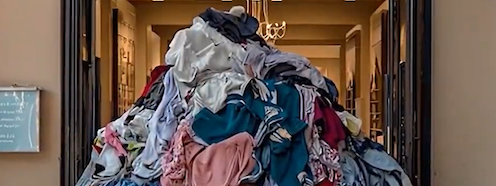
Can't Keep Up With
Laundry Anymore?

You're Not Doing Less. Life Is Just Asking for More.
A new baby. A job change. An illness, a loss, a caregiving responsibility that landed without warning. A schedule that quietly shifted until the routine that used to work just... doesn't anymore. Or maybe nothing you can point to — things just gradually got harder, and laundry is one of the places it's showing up first.
You're still trying. Running loads when you can, staying on top of it as best you can. And it's still not enough. The pile grows anyway. The clean laundry sits in the basket waiting to be folded. The hamper fills up faster than you can empty it. You're doing what you've always done, and it's not working the way it used to.
That gap between effort and result is real. And it's not because you got worse at laundry.

When "I Used to Manage This Fine" Stops Being True
There's a particular kind of frustration that comes with this. Not the frustration of never having figured something out — the frustration of knowing you had it handled, and watching that quietly change.
Life transitions have a way of reorganizing your capacity without announcing themselves. A new baby who multiplied the household laundry overnight. An illness — yours or someone else's — that redistributed where your energy goes. A move, a loss, a shift in schedule you're still adjusting to. Laundry is often one of the first places the reorganization shows up, because it's relentless enough that any reduction in bandwidth shows immediately.
Other times there's no single moment you can point to. Things just gradually got harder. The routine that used to work stopped working. You started the week a load behind and couldn't quite catch up. Something changed, even if you can't name exactly what.
Both are real. And neither means you're failing.
The Weight of Trying and Still Falling Short
What makes this version of laundry overwhelm particularly wearing isn't the pile itself — it's the effort that went into it anyway.
You did the laundry. You stayed on top of it as best you could. You didn't stop caring. And still, here you are, behind. That gap — between the effort you're putting in and the ground you're losing anyway — has a specific kind of discouragement attached to it. It makes you question whether trying more will even help.
It won't, if the capacity shift is real. What you could manage at one point in your life isn't necessarily what you can manage now, and that isn't weakness — it's just true. The version of you who had the laundry handled was working with a different set of demands. This version of you is doing the best it can with what's actually on your plate.
Capacity Changes. Your Options Can Too.
Getting help with laundry isn't a sign that you've given up. It's an acknowledgment that what you're carrying right now is heavier than it used to be — and that there are practical ways to set some of it down.
When you're ready to look at what that actually involves — how pickup and wash-and-fold services work, what they cost, how to figure out if they make sense for your household right now — our guide for being overwhelmed by laundry walks through all of it. Real options, clearly laid out, for people who are already trying hard and need something to actually change.
Common Challenges