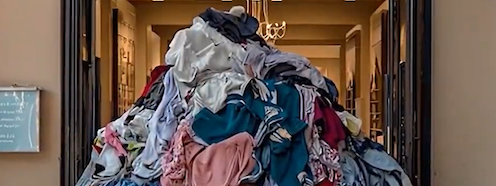
Behind On Laundry
and Don't Know Where
to Start?

The Pile Isn't the Problem. The Pile Is What Happened While You Were Dealing With Everything Else.
At some point the laundry stopped being something you were behind on and started being something you were avoiding. Not because you're irresponsible, and not because you don't care — but because it got big enough that it started feeling pointless. Like bailing out a boat with a cup. Why begin when you can already see how far you have to go?
So the pile stayed. And then it grew a little more. And now it's not just a chore anymore — it's a thing you walk past and feel bad about, which somehow makes it even harder to start.
That feeling has a name. And it makes complete sense.

What Paralysis Actually Feels Like
It's not that you forgot about the laundry. You're aware of it constantly. It's the first thing you see in the morning and the last thing you notice before bed. You think about it on the way to work. You tell yourself you'll do it tonight, and tonight comes, and the pile is still there, and you are tired in a way that makes pulling it apart and sorting it feel genuinely impossible.
So you do nothing. And because you did nothing, tomorrow the pile is the same size, and the guilt is a little heavier, and starts feeling a little harder.
This is the cycle that doesn't get talked about enough — not the laundry itself, but the way falling behind changes your relationship with it. The pile stops being a chore and starts being evidence. Evidence that you're behind, that you dropped the ball, that somehow everyone else is managing this and you're not. None of that is true. But it's hard to step into a room full of laundry and not feel it anyway.
The Load That's Been in the Washer Since Tuesday
There's one particular feature of the behind-on-laundry experience that almost everyone who's been there recognizes: the re-wash.
You put a load in. Life intervened — a phone call, a work crisis, a kid who needed something, plain exhaustion. The load sat in the washer overnight. Maybe two nights. Now it smells like it sat in the washer overnight, and the only option is to run it again, and so you do, and then the same thing happens, and somehow this one load has been "in progress" for four days and you still don't have clean clothes.
The re-wash cycle is one of the most demoralizing parts of falling behind on laundry because it creates the sensation of doing work with nothing to show for it. You ran the machine. You came back. You're further behind than when you started. It makes the whole project feel rigged.
If that's where you are right now, it might be worth skipping the cycle entirely. See what a reset actually looks like →
What People Try When They Finally Decide to Tackle It
When the guilt tips over into action, most people approach the backlog the same way: everything at once. Every basket, every pile, every item that's been living on the floor gets sorted into a mountain, and the plan is to just run loads until it's done.
This works, sometimes, partially. It also takes an entire day, creates decision fatigue before you're halfway through, and still leaves you with a fresh load of regular laundry due by Tuesday. Even on the days you successfully catch up, "caught up" lasts about 48 hours before the cycle starts again.
The other version is the quiet creep — one load here, one load there, chipping away slowly enough that it doesn't feel overwhelming. This is gentler on your bandwidth. It also means living with the pile for weeks while it very slowly shrinks, which is its own kind of low-grade stress.
Neither is wrong. But both assume that working through the backlog yourself is the only path forward.
You're Allowed to Hand This One Off
Here's something worth saying plainly: being behind on laundry is not a character flaw, and not everything that piles up has to be dealt with by the person it piled up on.
Wash-and-fold services and laundry pickup apps exist precisely for moments like this — when the volume has grown past what feels manageable and a reset would change everything. You hand it off. It comes back clean, folded, and done. Not partially done. Not in progress. Done. The backlog clears, the guilt clears with it, and the ongoing laundry feels like a chore again instead of a consequence.
Common Challenges