Apartment Living
Without Laundry

No Hookups, No Machine. Just a Recurring Problem You've Learned to Work Around.
Living in an apartment without a washer or dryer isn't unusual — for a significant portion of urban renters, it's just the reality of the lease they signed. What's less discussed is how much low-grade friction that reality introduces into an otherwise manageable week. Not a crisis, not a dealbreaker, but a persistent inconvenience that never quite becomes invisible no matter how long you've been dealing with it.
You've probably found a workable solution by now. Workable doesn't always mean good. And good enough tends to feel less good the longer it stays the only option you've seriously considered.
The Shared Laundry Room Problem
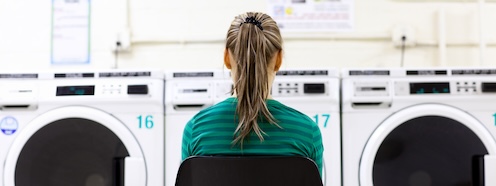
For apartments with on-site laundry facilities, the setup sounds reasonable in theory: machines a short walk away, no need to go anywhere, problem solved. In practice, shared laundry rooms introduce a different set of frustrations.
Availability is the primary one. In buildings with more residents than machines — which is most buildings — laundry timing becomes a game. Weekend mornings are congested. Evenings after work fill up fast. The machines that were free when you checked twenty minutes ago are taken by the time you get there with your bag. And the informal social contract of shared laundry — leaving machines free promptly, not moving other people's wet clothes — gets violated often enough to make every visit slightly uncertain.
There's also the maintenance reality. Shared machines in apartment buildings absorb heavy use and don't always receive proportionate maintenance. A machine that works today may not work next week, and when it breaks the repair timeline is someone else's problem to manage on someone else's schedule.
For buildings without on-site facilities, the calculation shifts to a laundromat, which means factoring in travel, availability, and consolidated blocks of time on a schedule that was already full.
What Lease Conditions Actually Allow
One fix that seems obvious — bringing in a portable or countertop washer — runs into lease restrictions more often than people expect. Most apartment leases prohibit installing machines that require permanent plumbing connections, and some prohibit portable units that connect to a sink. Violations can trigger lease penalties or forfeiture of security deposits.
Before investing in any appliance-based workaround, the lease is worth reading carefully. What seems like a practical short-term fix can create a longer-term problem that wasn't worth the convenience. Most portable washing solutions also don't fully replace a standard machine cycle — they're adequate for small loads of lightly soiled clothing and significantly less useful for anything heavier, bulkier, or more than a few items at a time.
The Budget Math Over Time
The cost calculation for apartment laundry without in-unit machines is worth doing explicitly, because the per-trip cost of a laundromat can feel modest while the annual cost accumulates into something more significant.
At $3–$5 per wash cycle and $2–$4 per dryer cycle, a household running three loads per week spends roughly $780–$1,400 per year at a laundromat — before factoring in transportation, detergent purchased in smaller and therefore more expensive quantities, and the time cost of the visits themselves. For people living in cities where time is the scarcer resource, that time cost can exceed the cash cost.
Wash-and-fold pickup services typically run $1.50–$2.50 per pound, with most single-person households sending 8–12 pounds per week. At the midpoint of that range, the annual cost lands in a range comparable to regular laundromat use — often within a few hundred dollars in either direction — with significantly less time required. For urban renters trying to decide whether pickup service is financially reasonable as a long-term arrangement, the gap between the two options is frequently smaller than assumed.
Building a Routine That Actually Works
The challenge of apartment laundry without in-unit machines isn't just logistical — it's habitual. In-unit machines allow laundry to happen as an incidental task, woven into the day. Without them, laundry requires deliberate scheduling: choosing a time, getting to a machine, staying present for the cycle, or coordinating a pickup. It's a chore that has to be planned rather than absorbed.
The routines that tend to hold are the ones that match the actual rhythms of the week — not an idealized version of it. For people with predictable schedules and a nearby laundromat, a fixed weekly laundry window can work well. For people with variable schedules, client obligations, or weeks that rarely go as planned, a routine that depends on being available at a specific time tends to break down exactly when it's most needed.
Pickup and delivery services fit the second profile better than the first. Because pickup can be scheduled on demand — without requiring you to be present for the process — the routine becomes scheduling a pickup when the bag is full, rather than arranging your week around a laundry window. For urban renters whose weeks are unpredictable, that flexibility is often the difference between a laundry system that holds and one that regularly falls apart.
What Apartment Living Without Laundry Actually Calls For
The right solution for apartment living without in-unit machines isn't the same for everyone. A nearby laundromat with good machines and reliable availability might be genuinely sufficient. Shared building laundry that's actually accessible at the times you need it might work. A pickup service that removes the logistics entirely might be worth the cost for what it gives back.
What most apartment dwellers without laundry eventually conclude is that the solution that fits isn't the one that's cheapest in cash — it's the one that eliminates the most friction for the way they actually live. If you're still working that out, there's more to consider on the next page, including a fuller look at what each option involves and how to find what's available where you live.
Common Challenges