Tired of Going to
the Laundromat?

You Go Because You Have To. Not Because It Works.
The laundromat gets the job done. That's about the most generous thing most regular laundromat users would say about it. You go, you wait, you come back with clean clothes. The laundry is handled. And then next week you do it again, and the week after that, and at some point the cumulative weight of it starts to feel like more than a chore — it feels like a tax on your week that you didn't agree to and can't seem to stop paying.
If you've settled into laundromat visits as just the way things are, this page is worth reading. Not because there are tips for making it better — there aren't many — but because the assumption that this is your only option may not be as solid as it feels.
The Part That Starts Before You Even Get There
Laundromat trips don't begin at the laundromat. They begin with gathering — pulling clothes from wherever they've accumulated, consolidating them into bags heavy enough to be awkward, figuring out whether you have quarters or whether the app works or whether the machines at this particular location take cards. Then getting the bags to the car, or onto public transit, or down the block.
By the time you walk through the door, you've already done twenty minutes of work that in-unit laundry would have absorbed invisibly. The laundromat is the destination of a trip you didn't want to take, carrying weight you'd rather not carry, at a time that probably wasn't your first choice.
Then There's the Waiting
This is the part that's hardest to account for in how much the laundromat actually costs you.
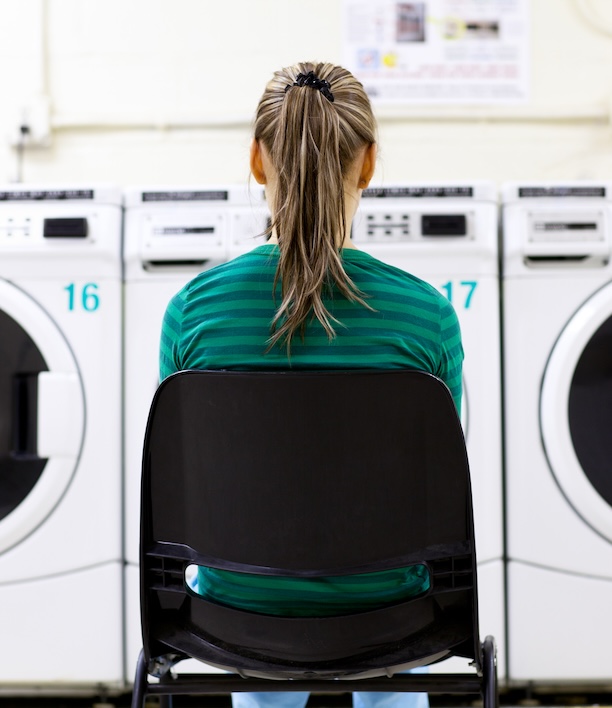
The machines run for 30 to 45 minutes for a wash cycle. The dryer runs for another 45 to 60. You're not doing laundry during that time, but you're not free either. You're in a plastic chair under fluorescent lighting, watching a drum turn, scrolling your phone, waiting. You could be doing something else — except you can't leave, because the machines will finish and your clothes will sit there getting wrinkled, or someone will need the machine and move your wet load to a folding table, or your dryer will stop and the clothes will cool into a damp heap that doesn't quite dry unless you run it again.
So you stay. An hour and a half, two hours, sometimes more if the machines are slow or you're running multiple loads. That's not a few minutes absorbed into a morning. That's a block of time, gone, every single week.
The Folding Problem
Folding at the laundromat is a specific kind of indignity. The folding tables are shared, sometimes sticky, always public. The person next to you is also folding. Your clothes are hot and slightly awkward to fold standing up at a surface that's the wrong height. You're trying to move efficiently because other people are waiting for the table and you don't want to be the person who holds it up.
There's no good way to fold a fitted sheet in a laundromat. There's barely a good way to fold anything. What most people end up with is a pile that's approximately folded, stuffed back into bags, and finished at home on the couch — which adds another task to the end of a trip that was already too long.
The Assumption That Keeps People at the Laundromat
The most significant thing keeping regular laundromat users at the laundromat isn't the cost or the habit. It's the belief that it's the only realistic option available.
Wash-and-fold pickup services have expanded significantly in recent years and are now available in many cities and towns where laundromats are the default. The model is simple: your laundry is picked up from your door, washed, dried, and folded by someone else, and returned. You don't haul anything. You don't wait anywhere. You don't fold on a public table. The laundry gets handled without any of the parts that make the laundromat wearing.
The cost is often closer to what most people pay at the laundromat than they expect — particularly when the time cost of laundromat visits is counted honestly alongside the cash cost. For people who've accepted laundromat trips as the unavoidable price of not having in-unit machines, discovering that the math is closer than assumed tends to reframe the decision.
That doesn't mean it's the right option for everyone. But assuming it isn't before checking is worth reconsidering.
There's more here on how the options compare — and how to find what's available where you live.
Common Challenges